
In the high-stakes theater of Los Angeles production, the most expensive venue is rarely the one with the highest line item. It’s the one that fails to protect your schedule against technical obsolescence and logistical friction. You likely recognize that managing production location fees in this market often feels like deciphering an opaque manuscript, particularly when unexpected costs emerge during wrap or when the romantic allure of a historic space lacks the technical resilience required for modern digital capture.
This guide provides a definitive framework for mastering these complexities by exploring the intersection of architectural heritage and elite infrastructure. We will show you how to secure a location that balances Art Deco grandeur with seamless, high-status execution. We’ll also examine the latest 2026 regulatory shifts, such as the $350 low-impact permit options and Culver City’s innovative fee waivers, to ensure your next project remains both fiscally disciplined and technologically superior.
Key Takeaways
- Decode the nuanced distinctions between commercial and independent fee structures to align your budget with Southern California’s specific industry standards.
- Quantify the “Footprint Factor” by analyzing how crew volume and extended 14-hour production days influence your primary pricing tiers.
- Master the complexities of production location fees by identifying the long-term savings inherent in turnkey venues with pre-integrated, high-tier technical infrastructure.
- Optimize your financial allocation through rigorous technical scouts and multi-day bundling strategies that streamline prep, shoot, and wrap logistics.
- Discover how a visionary blend of historic Art Deco design and $20 million in modern technological upgrades creates a frictionless environment for elite productions.
Defining Production Location Fees in the Los Angeles Media Landscape
In the sophisticated ecosystem of Southern California media, production location fees represent far more than a simple transaction for square footage. They function as comprehensive service agreements that grant a production team the exclusive right to transform a physical space into a narrative asset. This multifaceted arrangement covers the legal right to capture imagery, the utilization of specialized on-site utilities, and the professional coordination required to manage a high-density crew. Understanding these fees is a core component of film budgeting, where the distinction between commercial, editorial, and independent structures dictates the financial trajectory of the entire project.
Commercial campaigns typically command a premium due to their high-impact footprints and immediate revenue expectations. Editorial shoots often operate on mid-tier scales that prioritize aesthetic prestige. Independent film structures in Los Angeles frequently utilize tiered pricing that respects the creative vision while maintaining the venue’s operational integrity. A robust location agreement serves as the foundational protection for both parties; it secures the production’s right to the captured footage while providing the venue with a definitive framework for asset protection and liability coverage. By 2026, the standard for a premier location has shifted. Venues are no longer just passive backdrops. They’re active production partners that must provide the technical resilience, high-capacity power, and digital connectivity required for modern, high-resolution workflows.
The Core Components of a Professional Site Fee
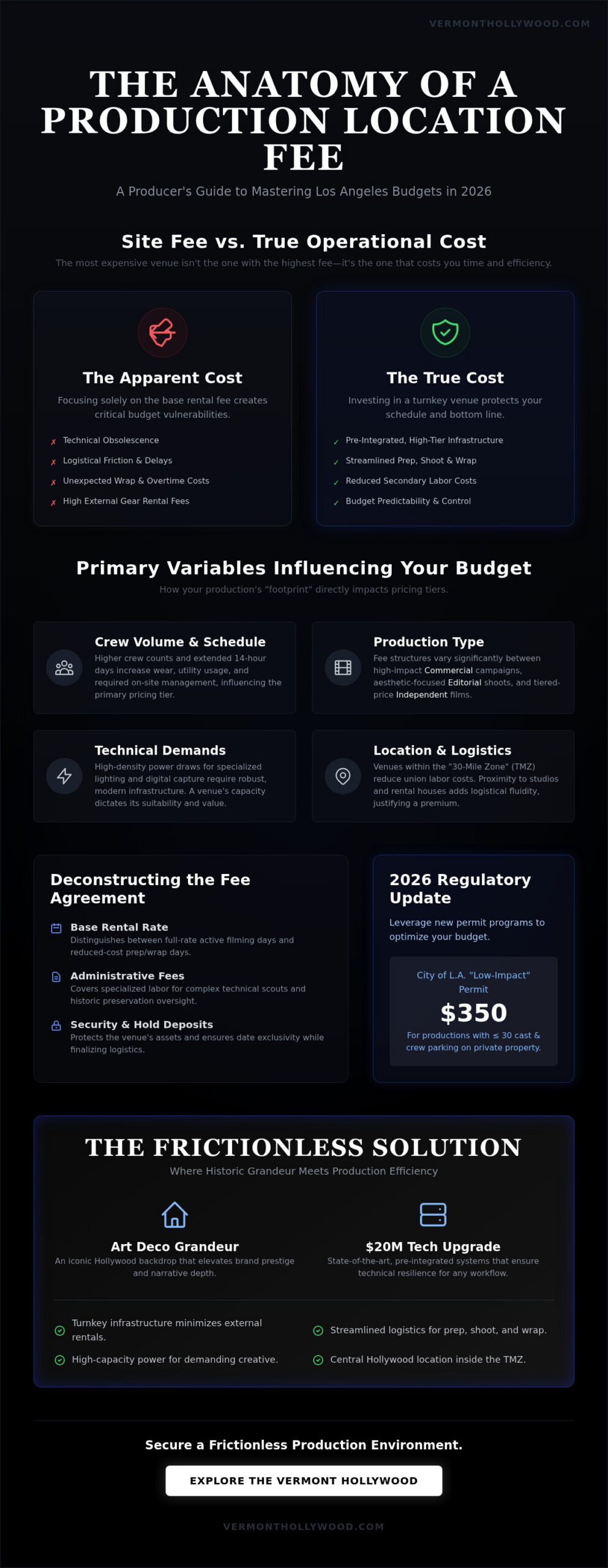
A transparent fee structure begins with the base rental rate, which distinguishes between active filming days and the reduced costs of prep and wrap days. Professional venues often implement administrative fees to cover the specialized labor required for historic preservation or the coordination of complex technical scouts. You’ll also encounter security deposits designed to protect the venue’s architectural heritage and “hold” fees that ensure your tentative dates remain exclusive while you finalize your talent and crew logistics.
Why Los Angeles Location Fees Carry a Premium
The Los Angeles market operates with a unique gravity influenced by the “30-mile zone” (TMZ). This radius determines union per diems and travel distances, making centrally located venues highly coveted for their ability to reduce secondary labor costs. Proximity to major studios and elite rental houses adds a layer of logistical fluidity that justifies a higher initial investment. Ultimately, an iconic Hollywood zip code offers a level of brand prestige and technical reliability that cheaper, remote alternatives simply cannot replicate. The investment ensures that your production location fees buy you more than space; they buy you a frictionless, high-status environment where every variable has been pre-calculated for success.
Primary Variables Influencing Your Production Location Budget
Precision in budgeting requires an intimate understanding of the variables that transform a raw space into a high-functioning set. In the Los Angeles market, 2026 standards have introduced a more granular approach to how production location fees are calculated, moving away from flat rates toward tiered structures based on impact and technical demand. Your financial strategy must account for the intersection of crew density, architectural vulnerability, and the specific regulatory environment of the chosen municipality. For instance, savvy producers now leverage the City of Los Angeles “low-impact” permit program, which as of April 2026, offers a reduced $350 permit fee for productions with 30 or fewer cast and crew members who can park on private property. This regulatory shift directly influences how venues price their smaller-scale editorial and brand activation tiers.
Beyond the permit, the physical footprint of your production dictates the complexity of the site’s operational support. High-status venues with significant architectural heritage, particularly those featuring pristine Art Deco elements, necessitate specialized oversight and protective measures that are factored into the base rate. You aren’t just paying for the aesthetic; you’re investing in the technical resilience of a space that can handle high-density power draws for specialized lighting rigs without compromising its historical integrity. Producers seeking a venue that integrates these technical requirements while maintaining an iconic aesthetic often turn to vermonthollywood.com for its turnkey production capabilities and visionary design.
Crew Size and Equipment Density
Venues typically categorize productions into tiers to manage the logistical weight of the project. A Tier 1 still shoot requires minimal footprint, whereas a Tier 3 large-scale film production involves a fleet of trucks and trailers that demand dedicated staging areas. These logistical support fees cover the increased wear on the facility and the necessity of specialized holding areas for talent and background players, ensuring the main production space remains clear for the creative team.
Operational Hours and Overtime Structures
The duration of your shoot day is perhaps the most volatile variable in your budget. While a standard 10-hour day is the baseline, the transition into a 14-hour production day triggers significant shifts in operational costs and staffing requirements. Budgeting for the “Golden Hour” and late-night wrap logistics is essential for maintaining a frictionless experience. Efficient load-in and load-out schedules are not merely logistical preferences; they’re financial imperatives that prevent your production location fees from escalating into punitive overtime territory. Mastering this rhythm allows you to maximize the cinematic potential of the space without exceeding your fiscal boundaries.
Evaluating Site Fees vs. Operational Costs: The Total Cost of Production
True fiscal mastery in the Los Angeles market requires a shift in perspective from “price per day” to “total cost of capture.” While a raw industrial space might present an attractive entry point for production location fees, the hidden operational costs can be staggering. You’re not just renting floor space; you’re inheriting a logistical vacuum that must be filled with expensive temporary infrastructure. Importing massive power generators, paying for the drayage of lighting trusses, and hiring additional labor for complex load-ins can quickly double your effective daily rate.
Choosing a venue with pre-existing technical superiority creates a frictionless environment where your budget is spent on what appears on screen, not the mechanics behind it. High-status productions prioritize venues that have already invested in technological resilience, allowing for a more cinematic and efficient workflow. This strategic selection ensures that the venue functions as a partner in your creative process rather than a mere backdrop. For a comprehensive breakdown of how to evaluate these trade-offs, the professional guide to film & TV shoot location rental in Los Angeles offers an in-depth framework for balancing cinematic heritage with modern technical demands.
Built-in Tech vs. Third-Party Rentals
The ROI of built-in LED walls and concert-grade sound systems is found in the reduction of third-party vendor coordination and the elimination of rental house markups. When a venue provides a visionary blend of 1920s aesthetics and 2026 digital infrastructure, you gain access to high-capacity power and secure fiber internet without the need for external augmentation. This integrated approach allows for seamless DIT data transfers and high-fidelity live-streaming, ensuring that your digital assets are protected and transmitted with absolute reliability. By utilizing venue-provided backline and lighting rigs, you significantly decrease the logistical weight of your production.
Mandatory Personnel and Compliance Fees
Protecting the meticulous details of a historic location requires the presence of a professional Site Representative who understands the minutiae of architectural preservation. This individual serves as an expert curator during your shoot, guiding your team through the safe utilization of the space while preventing accidental damage to delicate Art Deco finishes. Compliance with local safety regulations is equally critical. As of April 2026, the City of Los Angeles has streamlined the process by waiving the $285 Fire Department spot check fee for low-impact productions, but larger-scale projects must still account for dedicated Fire Marshals when managing pyrotechnics or significant background crowds. These compliance fees, alongside professional janitorial and restoration services, are essential investments that guarantee a sophisticated and successful wrap.
Strategic Budgeting: How to Optimize Your Production Location Spend
Optimization of your production spend is a meticulous exercise in technical foresight and logistical orchestration. It isn’t merely about finding the lowest entry price; it’s about identifying a venue whose existing infrastructure absorbs the costs that typically inflate a line producer’s budget. By shifting the focus from raw square footage to integrated service capabilities, you ensure that your production location fees translate directly into higher on-screen production value. This strategic approach requires a deep dive into the venue’s physical and digital architecture long before the first truck arrives on site.
Maximizing the Technical Scout
A professional technical scout serves as the primary defense against unforeseen labor costs and equipment overages. During this phase, your department heads should identify precise power drop locations to minimize expensive cable runs and the associated labor required for complex rigging. In spaces with significant architectural heritage, evaluating the interplay between natural light and the venue’s internal lighting systems can reveal opportunities to reduce your rental package. For those seeking the perfect fusion of past and future, checking historic theater rental availability allows you to secure a space that has already been optimized for multi-use production requirements.
The Logistics of Multi-Day Bookings
Efficiency in scheduling is a powerful lever for budget optimization. Multi-day bookings allow you to take advantage of prep and wrap rates, which are typically billed at 50% of the standard shoot day fee, significantly lowering the total cost of production. Scheduling your shoot around existing venue events, such as concert or comedy nights, can often lead to more favorable rate structures by utilizing existing setups. Choosing a venue with a dedicated on-site production office eliminates the need for temporary trailer rentals and provides your core team with a sophisticated, secure base of operations.
Leveraging the venue’s existing VIP hospitality suites for talent holding and client areas is another hallmark of a sophisticated budget strategy. Using these high-end, pre-furnished spaces removes the need for external furniture rentals or additional staging labor. You should also ensure all Certificate of Insurance (COI) requirements are meticulously met well in advance to prevent costly delays on day one. When you align your project with a venue of significant prestige, the negotiation becomes a partnership based on shared excellence and long-term industry value. Reserve your production dates at The Vermont Hollywood to experience a venue designed for maximum logistical fluidity and cinematic impact.
The Vermont Hollywood: Where Historic Grandeur Meets Production Efficiency
The search for a venue that honors the cinematic heritage of Los Angeles while providing the technical resilience of a 2026 soundstage concludes at The Vermont Hollywood. Spanning 13,000 square feet of meticulously curated space, this multipurpose destination represents the logical conclusion for high-impact brand activations and elite film shoots. While other guides might suggest that venues are mere backdrops, we recognize that a truly professional location is an active participant in your production’s success. Our $20 million renovation has forged a visionary blend of 1920s cinematic grandeur and cutting-edge infrastructure, ensuring that your production location fees are an investment in technical fluidity rather than just a cost for occupancy.
Mastering the specifics of the Southern California market requires a partner that understands the minutiae of high-stakes media capture. By choosing a space that has already internalized the costs of high-density power and concert-grade acoustics, you bypass the logistical vacuum common in raw industrial rentals. This integrated approach allows your team to focus on the creative execution, knowing that the physical environment has been engineered for maximum efficiency and cinematic impact. The result is a frictionless experience that protects your timeline and your budget simultaneously.
Unrivaled Technical Resilience for Media Production
The facility features state-of-the-art LED infrastructure and concert-grade acoustics that provide a pristine canvas for both TV capture and live performance. Our commitment to technological longevity is evidenced by proprietary digital security systems that protect high-profile assets from the moment of capture through final data transfer. The Vermont Hollywood stands as an uncompromising, tech-forward sanctuary where modern cinematographers can execute complex visual narratives within a secure, high-fidelity environment.
Luxury Hospitality Meets Professional Utility
We’ve reimagined traditional hospitality elements to serve the specific needs of the production community. Our VIP table reservations function as sophisticated green rooms, providing talent with a sanctuary of luxury and privacy that far exceeds the utility of a standard holding area. Professional site management remains on hand to ensure that every minute of your schedule is protected, moving your project from load-in to wrap with practiced precision. You can book your next film & TV shoot location rental at a venue designed for excellence, where every detail has been pre-calculated to justify your investment in production location fees and elevate your final output.
Secure Your Legacy in the New Era of Production
Mastering the intricacies of the Los Angeles market requires moving beyond the surface of line-item expenses to embrace a holistic view of technical and architectural value. You’ve gained the framework to distinguish between raw occupancy costs and the strategic advantages of integrated infrastructure. By prioritizing venues that offer built-in technological resilience, you ensure that your production location fees function as a catalyst for cinematic excellence rather than a drain on your operational resources.
The Vermont Hollywood stands as the definitive choice for those who demand a frictionless transition from visionary concept to high-fidelity capture. Our 13,000 square feet of versatile space features a meticulous $20 million renovation that seamlessly embeds 2026 production capabilities within iconic Art Deco architecture. We invite you to experience a venue where every technical variable has been pre-optimized for your success. Inquire About Production Rates at The Vermont Hollywood to secure a location that reflects the prestige of your next project. It’s time to bring your most ambitious creative endeavors to life in a space built for the future.
Frequently Asked Questions
What is the average production location fee for a professional venue in Los Angeles?
Market rates for professional spaces vary significantly based on the venue’s technical infrastructure and the total square footage required for the shoot. A premium 13,000 square foot space in Hollywood commands a different rate than a raw industrial warehouse due to the inclusion of integrated technology. Professional production location fees are generally scaled according to the production’s impact tier and the specific logistical demands of the crew.
Do production location fees include prep and wrap days?
Prep and wrap days are typically billed as separate line items at a reduced rate, which is often 50% of the standard daily shoot fee. This allows the production team to manage load-in and set dressing without the financial burden of a full filming rate. Scheduling these days effectively is a hallmark of a disciplined budget, ensuring the creative team has the necessary time for technical calibration before cameras roll.
What additional costs should I budget for besides the base location fee?
You should account for mandatory personnel, specialized insurance premiums, and post-production restoration costs. Site representatives, fire marshals, and dedicated security teams are often billed separately to ensure the safety of both the crew and the facility. Additionally, consider the costs of high-capacity power usage and professional janitorial services required to return a historic space to its pristine condition after the production wraps.
Are site representatives and security included in the location rental price?
Site representatives and security personnel are frequently treated as essential, billable additions rather than being bundled into the base rental price. These experts are tasked with protecting the venue’s architectural heritage and managing proprietary digital security systems during high-profile shoots. Separating these costs allows the venue to provide a tailored level of oversight that matches the specific footprint of your project.
How does a historic or Art Deco status affect the production fee?
Historic status often commands a premium due to the specialized oversight and preservation measures required to maintain delicate heritage elements. Venues with significant architectural value necessitate the presence of expert site representatives to guide the crew’s interaction with the space. This investment provides an unrivaled cinematic backdrop and a level of brand prestige that elevates the visual impact of the final media asset.
Can I negotiate production location fees for independent or small-scale projects?
Negotiation is often possible, particularly for productions that qualify for the City of Los Angeles “low-impact” permit program as of April 2026. This initiative allows crews of 30 or fewer to access professional environments with reduced administrative costs. Independent producers can often secure more favorable rates by scheduling their shoots around existing concert or comedy events or by bundling multi-day schedules into a single agreement.
What insurance coverage is required to book a high-end production location in LA?
Most high-status venues require a comprehensive Certificate of Insurance (COI) with general liability coverage typically ranging from $1 million to $5 million. The policy must name the venue as additionally insured to protect against accidental damage to high-tech infrastructure or historic finishes. Finalizing this documentation well in advance is a critical step in ensuring a frictionless load-in and preventing costly schedule delays.
Are utilities like high-speed internet and power typically included in the fee?
Utilities such as secure fiber internet and high-density power are often built into the production location fees at premier, turnkey facilities. This provides a distinct advantage over raw rentals where you must coordinate external generators and temporary data solutions. Accessing pre-integrated, resilient systems ensures a seamless workflow for DIT data transfers and high-fidelity live-streaming without the need for secondary vendor management.