The era of measuring a concert’s success by its sheer volume is officially over, replaced by a new gold standard defined by the invisible precision of immersive audio. You’ve likely endured the frustration of a “muddy” set where vocals are swallowed by distorted bass, or felt the physical toll of ear fatigue caused by poorly balanced frequencies. It’s a common disappointment that separates standard halls from world-class destinations. This article explores the sophisticated world of concert sound technology, revealing how a meticulously engineered signal chain transforms a simple performance into a breathtaking, high-fidelity experience.
By understanding the intersection of architectural acoustics and state of the art innovations, such as the L-Acoustics K3 system, you’ll learn how to identify venues that prioritize impeccable quality over mere noise. We’ll preview the future-proof software and precision hardware that ensure a seamless soundscape for every guest, regardless of where they stand in the room. Whether you’re a technical enthusiast or a casual fan, you’ll gain a new appreciation for the craftsmanship required to deliver flawless live audio.
Key Takeaways
- Understand the transition from traditional public address systems to the 2026 standard of “Immersive Reinforcement,” where sound is treated as a holistic, three-dimensional ecosystem.
- Trace the journey of a single note through the professional signal chain to appreciate the meticulous engineering required to deliver a definitive and distortion-free sonic landscape.
- Discover how historic Art Deco architecture and materials like plaster interact with high-frequency waves, presenting a unique challenge for modern acoustic design.
- Learn to use a professional checklist to evaluate concert sound technology before booking a venue, focusing on industry-leading hardware like L-Acoustics and d&b audiotechnik.
- Explore how a $20 million investment in future-proof technology can seamlessly preserve retro elegance while establishing a new gold standard for the Los Angeles live experience.
What is Concert Sound Technology? Beyond the Volume Knob
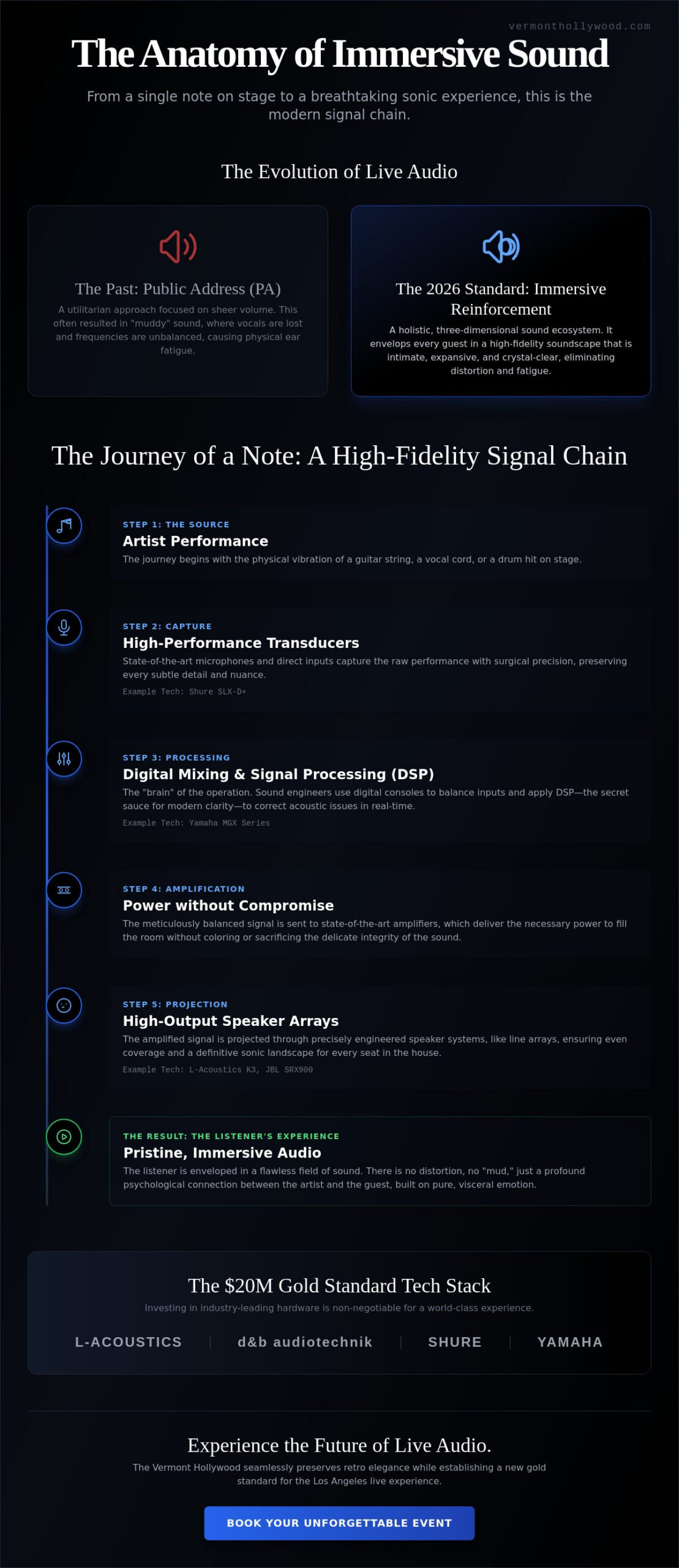
The definition of a world-class auditory experience has evolved far beyond the primitive reach of a simple volume knob. Today, concert sound technology represents a holistic ecosystem where the capture, processing, and projection of audio are treated as a single, unified craft of impeccable precision. In 2026, the industry has decisively shifted away from the utilitarian “Public Address” (PA) systems of the past toward “Immersive Reinforcement.” This philosophy ensures that every guest, whether they’re enjoying a VIP table reservation or standing at the front of the stage, is enveloped in a three-dimensional field of sound that feels both intimate and expansive. For premium Los Angeles venues, investing in this future-proof infrastructure is the only way to meet the expectations of an audience that demands flawless clarity and architectural harmony.
When audio is crystal-clear, it creates a profound psychological connection between the artist and the guest, stripping away the barrier of distance and replacing it with pure, visceral emotion. This isn’t just about hearing the music; it’s about feeling the texture of a vocal or the resonance of a kick drum as if you were standing inches from the source. A high-end concert sound technology setup eliminates the “muddy” frequencies that cause ear fatigue, allowing for a longer and more comfortable engagement with the performance. By prioritizing this level of detail, a venue transforms a standard night out into a landmark event that resonates long after the final encore.
The Core Components of a Modern Audio Rig
Achieving this level of excellence requires a sophisticated sound reinforcement system built on hardware that reflects a visionary dedication to craftsmanship. It begins with high-performance transducers and microphones, such as the Shure SLX-D+ systems introduced in January 2026, which capture the minute details of a performance with surgical precision. These signals travel to digital mixing consoles, like the Yamaha MGX series, which act as the “brain” of the operation. Here, sound engineers use programmable logic to balance dozens of inputs in real-time, ensuring the mix remains distinctive and plush. Finally, state of the art amplification delivers the necessary power to fill a room without ever sacrificing the delicate integrity of the original signal.
Digital vs. Analog: A Visionary Balance
While the industry moves toward digital efficiency, the most sophisticated spaces maintain a visionary balance by respecting the warmth of analog textures. This hybrid approach allows for the legendary “soul” of retro recordings to be projected through modern, high-output arrays like the JBL SRX900 series. Advanced software, such as L-Acoustics L-ISA 3.0, now plays a critical role in “tuning” a room, allowing engineers to calibrate the acoustics for everything from high-energy brand activations to intimate comedy shows. This digital infrastructure doesn’t just manage audio; it integrates with the venue’s virtually non-scalpable ticketing and production ecosystem to ensure a frictionless, high-end hospitality environment where technology meets the art.
The Signal Chain: How Sound Travels from Stage to Ear
The journey from a musician’s fingertips to the listener’s ear is a masterclass in high-fidelity engineering. This sequence, known as the signal chain, begins with the physical vibration of a guitar string or vocal cord, which is immediately captured by state of the art transducers. In a premium environment, the Front of House (FOH) philosophy focuses on creating a definitive sonic landscape where every frequency is curated for maximum impact. Behind the scenes of concert production, engineers utilize advanced Digital Signal Processing (DSP) to act as the secret sauce of modern clarity. DSP allows for real-time correction of acoustic anomalies, ensuring that concert sound technology delivers a pristine, uncolored representation of the artist’s intent. This digital precision eliminates the interference that historically plagued live shows, resulting in a plush and distinctive auditory profile.
Modern production standards have moved beyond simple amplification. The goal is now a seamless integration of every element in the signal chain, from the “future-proof” networked protocols like MILAN to the final projection through high-output arrays. This meticulous approach ensures that the energy of the performance is preserved perfectly, creating an enviable experience for those who value technical excellence. By treating the signal chain as a visionary ecosystem, venues can provide a level of craftsmanship that was previously only available in the most elite recording studios.
Spatial Audio and Immersive Soundscapes
The traditional stereo field, while classic, is no longer the pinnacle of the guest experience. Modern concert sound technology has embraced spatial audio to create a 360-degree environment that places the listener inside the music rather than in front of it. This innovation is particularly transformative for high-end brand activations, where programmable LED walls work in tandem with object-based audio to provide a multisensory journey. For those seeking the ultimate event, securing VIP table reservations ensures you are positioned perfectly within this immersive field. Spatial audio represents the ultimate evolution of live immersion.
Line Array Precision
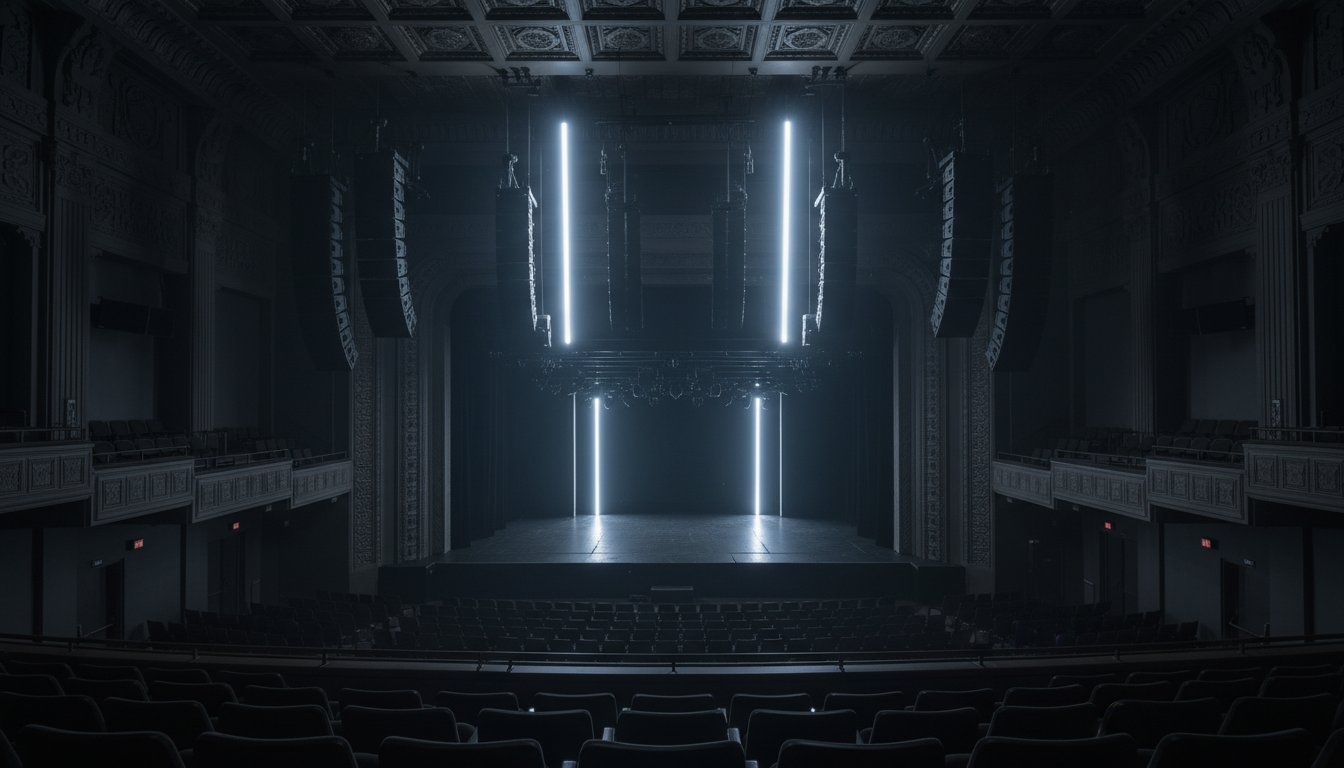
Line array systems have revolutionized how sound is projected across a venue, effectively eliminating the bad seat problem that plagued older concert halls. By stacking speaker modules in precise vertical columns, engineers can control the vertical dispersion of sound, significantly reducing the standard decibel drop-off associated with distance. In a venue like The Vermont Hollywood, which features the first permanent L-Acoustics K3 installation in North America, the rigging angles are calculated with impeccable precision to ensure the back row feels the same energy as the front. This level of craftsmanship ensures that even at levels reaching 120 dB, the audio remains balanced and distortion-free, protecting the audience from the muddy resonance found in lesser systems.
Acoustics vs. Architecture: The Hollywood Challenge
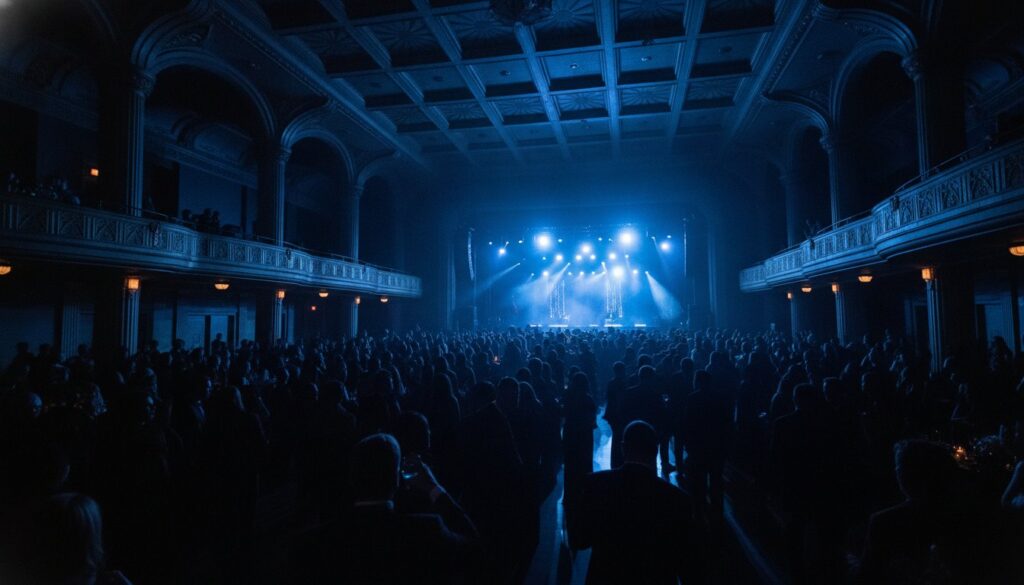
Hollywood’s architectural legacy presents a unique paradox for the visionary perfectionist. While Art Deco plasterwork and ornate wood paneling evoke a sense of timeless luxury, these materials are notoriously reflective, often causing high-frequency sound waves to bounce uncontrollably. Achieving 2026 audio standards within a historic shell requires a sophisticated integration of concert sound technology that remains invisible to the naked eye. It’s a delicate dance between preserving the retro aesthetic and implementing a future-proof acoustic environment. By embedding dampening materials and diffusion panels directly into the luxury design, a venue can maintain its distinctive character without compromising the integrity of the sonic experience. This invisible tech is what allows a space to feel like a high-end hospitality destination while performing like a surgical recording studio.
Multipurpose venues today must be flexible enough to host a high-energy brand activation one night and a nuanced film shoot the next. This requires an architectural philosophy where the physical space is as programmable as the digital consoles. By utilizing advanced modeling software, designers can predict how sound will behave within the specific geometry of a room, allowing for a layout that supports both the “wow factor” of a live show and the practical needs of a corporate rental. This intersection of architecture and acoustics is where the gold standard of live audio is truly established, ensuring the venue remains a leader in the competitive Los Angeles landscape.
Acoustic Treatment as Craftsmanship
Managing reflections across a sprawling 13,000 square foot space requires more than just standard insulation; it demands a fine attention to detail that treats acoustic treatment as a form of craftsmanship. Strategic placement of diffusers and absorbers ensures that standing waves are eliminated, creating a room that is “tight” and responsive. Major renovation projects, such as the $20 million investment at The Vermont Hollywood, prioritize this sonic integrity from the ground up. By utilizing spatial audio for live performance, engineers can now map the room’s specific geometry to optimize projection, ensuring that the architecture works with the technology rather than against it.
The Sonic Identity of Los Angeles Venues
The sonic identity of Hollywood is rooted in its history as the global epicenter of cinema, where spaces were originally designed for the nuanced requirements of film dialogue. Transitioning these rooms into high-performance concert halls requires a visionary balance between the “plush” comforts of a luxury lounge and the “hard” surfaces needed for high-impact audio projection. This intersection of modern innovation and retro charm is what makes the Los Angeles scene so enviable. Fans who secure concert tickets at these specialized venues aren’t just attending a show; they’re participating in a meticulously curated event where the architecture itself has been “tuned” for perfection. This commitment to concert sound technology ensures that the venue remains a leader in the entertainment landscape for decades to come.
How to Evaluate a Venue’s Sound Technology Before You Book
Selecting a venue for a high-stakes event is an exercise in discerning true quality from marketing hype. For the visionary perfectionist, the technical specifications of a space are just as vital as its aesthetic appeal. When you’re assessing a potential location, your first inquiry should always focus on the concert sound technology integrated into the architecture. A premium venue will proudly disclose its “PA” brand; look for industry leaders like L-Acoustics or d&b audiotechnik. These manufacturers represent the gold standard of audio engineering, ensuring that the system is capable of delivering the impeccable precision required for world-class performances. If a venue is vague about its hardware, it’s likely they haven’t made the necessary investment in a future-proof sonic environment.
Beyond the speakers themselves, the infrastructure supporting the audio is a critical indicator of excellence. You must confirm that the venue utilizes dedicated power circuits for the sound system to prevent interference from lighting rigs or kitchen equipment. This separation is essential for maintaining a clean, hum-free signal. Additionally, observe the “seamless and efficient” integration of the sound and lighting systems. In a state of the art facility, these elements work in a unified ecosystem, where programmable cues and synced data streams create a distinctive and polished atmosphere. To ensure your next production meets these rigorous standards, consider the advantages of a private event venue rental at a location designed with technical superiority in mind.
Questions for Event Producers
Producers must look beneath the surface to ensure a frictionless event-going experience. Ask if the venue provides a “future-proof” digital snake and stage box system, which utilizes fiber or Cat6 cabling to maintain signal integrity over long distances. In the crowded Los Angeles radio spectrum, wireless frequency management is another non-negotiable factor. Modern systems like the Shure SLX-D+, which offers a wide 138 MHz tuning range, are essential for avoiding dropouts. Finally, verify the presence of an on-site technical director who possesses the expertise to manage these complex systems with surgical precision throughout your event.
When coordinating high-stakes productions, it is often beneficial to partner with experts who understand these intricate technical requirements; for instance, you can learn more about Straight Street Event Services and their professional technical solutions for live and hybrid environments.
Signs of Sound Excellence for Concertgoers
For the discerning fan, several physical markers indicate a superior auditory experience. The relationship between the Front of House (FOH) booth and the stage is the most telling sign; if the engineer is tucked in a corner or behind a pillar, they aren’t hearing what you’re hearing. A well-calibrated system will also lack “boomy” or resonant bass, which is a hallmark of precision subwoofer placement and Digital Signal Processing. For a truly enviable perspective, look toward the VIP mezzanine. These elevated areas are often designed to offer a distinctive acoustic profile, balancing the direct energy of the line arrays with the natural resonance of the room’s Art Deco heritage.
The Vermont Hollywood: Where Future-Proof Tech Meets Retro Elegance
The Vermont Hollywood stands as the definitive intersection where 1920s Art Deco charm meets an aggressive, visionary pursuit of a future-proof identity. This isn’t merely a venue; it’s a $20 million technical masterpiece meticulously designed to redefine the Los Angeles entertainment landscape. By treating the architecture as a living extension of the audio rig, the space achieves a gold standard that moves away from the gritty atmosphere of traditional halls toward a polished, high-end hospitality vibe. Every decibel is curated with the fine attention to detail that only a visionary perfectionist can provide, ensuring that the “wow factor” of a live performance is never compromised by technical limitations. This commitment to concert sound technology positions the venue as a leader in a city that demands nothing less than the ultimate auditory experience.
At the heart of this technical soul is the first permanent North American installation of the L-Acoustics K3 system, a strategic choice that reflects a refusal to settle for anything less than impeccable precision. The rig features 16 K3 line array speakers paired with 6 KS28 subwoofers and 4 Kiva II front fills, all managed through industry-leading DiGiCo mixing consoles. This combination allows for a seamless and efficient workflow where digital programmable logic meets visceral acoustic energy. By integrating these state of the art components, the venue ensures a distinctive and plush soundscape that remains consistent whether you’re at the edge of the stage or enjoying the exclusive atmosphere of the mezzanine.
A Multipurpose Powerhouse
The facility’s versatility is a testament to its sophisticated design, allowing it to transition effortlessly between high-energy concert tickets and complex corporate brand activations. This flexibility is supported by a digital infrastructure that meets the rigorous standards of a premier film and TV shoot location. The intersection of luxury hospitality and high-tech production is evident in every corner of the 13,000 square foot space, where LED-lined walls and open-air patios complement the technical capabilities of the room. Whether hosting a private event or a televised production, the venue provides a frictionless environment where craftsmanship and modern innovation exist in perfect harmony.
Experience the Ultimate Sound
Guests are invited to feel the difference that a truly future-proof environment makes, moving beyond standard listening into a state of total immersion. For those who value quality and security, the venue’s use of virtually non-scalpable digital tickets and cashless points of purchase ensures a seamless journey from the entrance to the encore. Securing VIP table reservations offers more than just enviable views; it provides a curated acoustic perspective within a plush setting that represents the pinnacle of Hollywood’s nightlife. The Vermont Hollywood remains the definitive choice for those who refuse to compromise on quality, offering a world-class auditory experience that is as distinctive as the city itself.
Step Into the Future of Sonic Excellence
True auditory excellence requires a visionary balance of space and science. As you’ve discovered, the pinnacle of concert sound technology isn’t just about loudness; it’s about a meticulously curated signal chain that respects both historical craftsmanship and modern innovation. From the precision of line array rigging to the invisible art of acoustic diffusion, every element of a world-class venue is designed to eliminate ear fatigue and foster a deep, visceral connection with the performance. When you understand these nuances, you gain the power to choose environments where technical superiority and luxury hospitality coexist perfectly.
The Vermont Hollywood stands as the physical manifestation of this philosophy, boasting a $20 million state-of-the-art renovation that seamlessly integrates historic Art Deco elegance with future-proof production capabilities. Featuring an award-winning L-Acoustics K2 Sound System, the venue provides a distinctive and plush experience that serves as the benchmark for the Los Angeles entertainment landscape. We invite you to witness how fine attention to detail transforms a simple event into a legendary masterpiece. Experience the gold standard of sound-book your next event at The Vermont Hollywood today and ensure your production is nothing short of flawless.
Frequently Asked Questions
What is the difference between a standard PA system and concert sound technology?
A standard PA system is designed for basic public address and vocal projection, whereas modern concert sound technology is a holistic ecosystem engineered for high-fidelity immersion. While a basic PA might focus on sheer volume, a professional rig utilizes advanced processing to ensure every note is captured and projected with impeccable precision. This transition ensures that the performance isn’t just heard, but experienced as a distinctive and plush soundscape.
Why do some concert venues have better sound than others?
Superior sound is the result of a deliberate intersection between “future-proof” hardware and meticulous architectural calibration. Venues that prioritize the gold standard invest in premium brands like d&b audiotechnik or JBL’s SRX900 series, which was expanded in January 2026 to offer even greater point-source accuracy. Without this fine attention to detail, even the most expensive equipment can’t overcome the muddy resonance of a poorly treated room.
What is a “line array” and why is it used in professional venues?
A line array consists of multiple speaker modules stacked vertically to control the dispersion of sound waves and minimize decibel drop-off across long distances. This configuration is the industry standard because it ensures that guests in the back row experience the same energy as those at the front. By using vertical columns, engineers can direct audio with surgical precision, preventing unwanted reflections off the ceiling and floor.
How does the size of a venue affect the concert sound technology required?
Venue size dictates the scale of the “signal chain” and the complexity of the speaker deployment needed to fill the space without distortion. A 13,000 square foot space requires a specific balance of line array power and hidden acoustic dampening to prevent the muddy resonance often found in uncalibrated halls. Smaller spaces might rely on point-source systems, while larger environments require complex delay towers to maintain a seamless auditory journey.
Can digital technology fix a venue with poor acoustics?
Digital Signal Processing (DSP) can optimize a signal and mask minor flaws, but it can’t fully compensate for a venue with fundamentally flawed physical acoustics. The most successful spaces combine state of the art software with traditional craftsmanship, ensuring the architecture supports rather than hinders the technology. It’s a visionary balance where the digital brain and the physical shell work in perfect harmony.
Is spatial audio the future of live music performances?
Spatial audio is the current evolution of live performance, moving beyond traditional stereo to create a 360-degree field where individual sounds are placed in a three-dimensional space. Systems like L-Acoustics L-ISA 3.0, released with new “Stereo Mapper” features in early 2026, are already defining the next generation of live production. This technology allows for a more realistic and engaging experience that surrounds the listener entirely.
What should I look for in a venue if I am planning a high-tech corporate event?
For a high-tech corporate event, you should seek a venue with networked audio protocols like MILAN and dedicated power circuits that eliminate electrical interference. It’s also vital to ensure the soundscape integrates with programmable LED walls for a seamless and efficient brand activation. By consulting with experts in corporate AV services North Carolina, you can ensure that your chosen space offers the “future-proof” digital infrastructure required to support the complex needs of modern presentations and live streams.
Why is the sound different in the VIP section compared to the general floor?
Sound profiles vary because VIP sections are often architecturally separated to provide a distinctive and plush perspective of the performance. While the general floor offers the visceral energy of the main line arrays, elevated mezzanine seating is positioned to catch a more balanced, direct signal. This curated acoustic perspective is a hallmark of venues that prioritize a high-end hospitality vibe for every guest.